
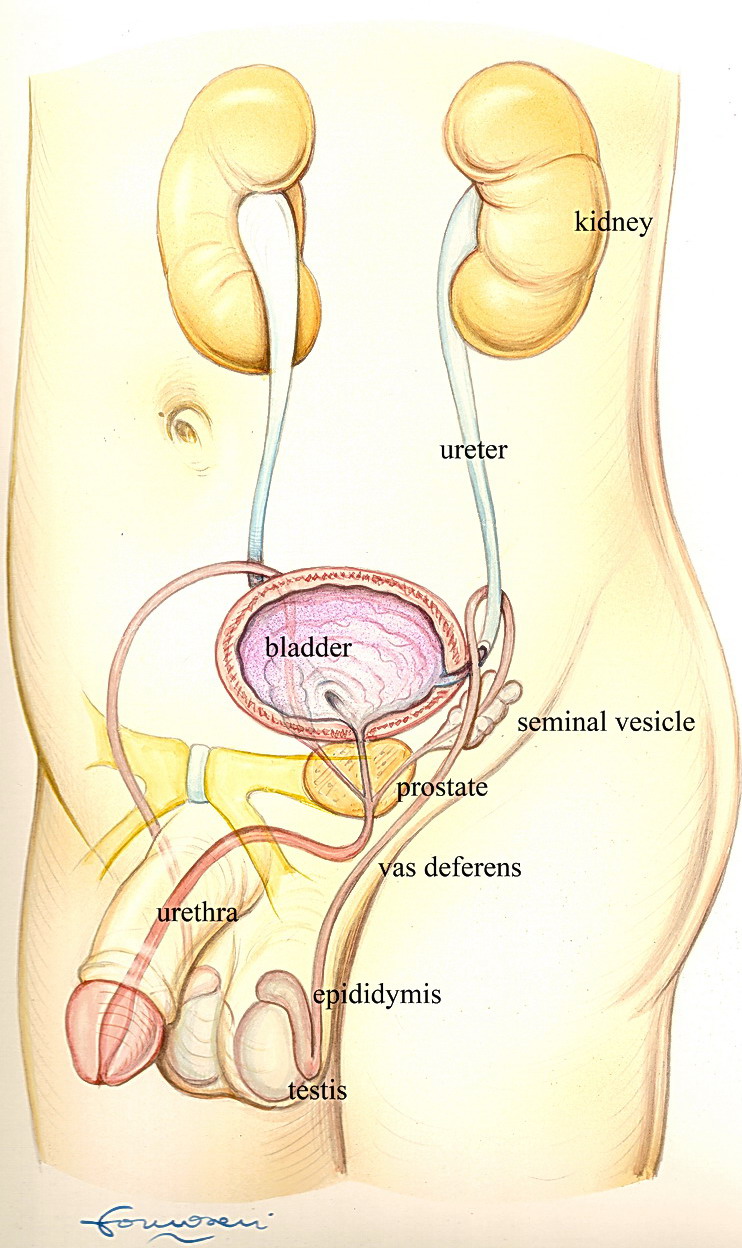
Benign Prostatic Hyperplasia
At the age of 30-35 years, the prostate begins slowly to
grow. The growth is benign (benign prostatic hyperplasia or
prostatic adenoma), with the shape of nodules (usually two,
one for each prostate lobe, right and left; sometimes a
central median lobe can be present). Benign prostatic
hyperplasia (BPH) rises from the inner part of the gland,
just close to the urethra, and progressively may obstruct the
passage of urine, narrowing the lumen of the urethra.
Nearly 50% of men at the age of 60 experience prostatic
enlargement. The occurrence of BPH reaches 90% in men over
80. About 50% of men with BPH will develop urinary symptoms.
Obesity and diabetes are risk factors for BPH.
The decreased diameter of the urethra, due to prostatic
enlargement, may lead to obstruction to urine passage. The
narrow way of the urethra causes an increased bladder
workload; the bladder must exert a higher pressure to empty.
The excess of work of the detrusor muscle can provoke urinary
symptoms, due to both prostatic obstruction and bladder
irritation.
The urinary flow can become weak, at times with several
repeated micturitions to void the bladder. At the end of
voiding, urinary dribbling may be present. Urinary frequency
is increased at day and night, and the patient can be
awakened several times at night by the need to urinate.
This can occur either cause the bladder doesn´t allow
complete filling anymore, or cause the bladder hasn´t
enough strength to empty entirely, with decreased storage
capacity.
Some patients may experience the need to urinate with some
delay in voiding (hesitancy).
Sometimes, due to increased bladder work, the detrusor
muscle may develop instability, with hyperactive
contractions. The need to urinate may be sudden, with a
strong desire to void that can´t be controlled
(urgency), with some urinary leakage if the bladder is not
voided within a short time (urge-incontinence). These
symptoms are known as Lower Urinary Tract Symptoms (LUTS).
There are some questionnaires, which were developed to
provide an objective evaluation of LUTS. They are based on a
score, with classification of the symptoms in mild, moderate
or severe. The most used is the IPSS, with score ranging from
0 to 35, where the symptoms are categorized as mild (0-7),
moderate (8-19), or severe (20-35).
On a long run, increased bladder pressure can lead to
urinary function damage, recurrent urinary tract infections,
or to bladder stones formation. According to some Authors,
chronic bladder inflammation, due to increased postvoiding
residual urine, might be a promoter of bladder cancer.
Sometimes the patient suddenly can´t void the bladder
at all (acute urinary retention), and a catheter must be
placed to empty the full bladder. There is a strong desire to
void, with suprapubic pain.
The catheter is removed after 3-4 days, to avoid the risk of
urinary infection related to an indwelling catheter. Usually
before catheter removal, treatment with alpha-blocker is
started, to increase the chance of spontaneous voiding
recovery.
About 50% of patients will return to spontaneous voiding at
catheter removal. Additional 25% of patients can void after
further catheterization for one week. One quarter of patients
can´t recover bladder voiding and require surgical
intervention (or indwelling catheter in case of surgery
contraindications).
BHP Diagnosis
Benign prostatic hyperplasia diagnosis is initially based
upon patient history. The questionnaires for objective
evaluation of urinary symptoms with an overall score are not
yet widely used on daily practice.
Digital Rectal Examination (DRE) gives an evaluation of
prostate size, firmness, and the presence of hard nodules
suspicious for cancer. All men above 50 years of age should
undergo digital rectal examination once a year. It is a basic
procedure for prostate evaluation.
Transrectal ultrasound (TRUS) of the prostate

|

|
is the procedure that can provide data concerning the size of
the gland, its structure, size of the adenoma,
tumor-suspicious nodules, and the degree and site of urinary
obstruction. It is performed by inserting an ultrasound probe
in the rectum. It should be done with full bladder. The
test is optional.
Uroflowmetry is a simple, non invasive test that measures
urinary flow, through a graphic. When the peak flow is above
15 ml/sec, usually patients are not obstructed. When the peak
flow is below 10 ml/sec, the patient is likely to have a
significative obstruction. The test is optional (but the
European Urology Association recommends it).
Pressure/flow studies and cystometry (known, together with
flowmetry, as urodynamics) provide important data on bladder
capacity and sensitivity, on bladder pressure at voiding, but
they are invasive. They are not routinely diagnostic tests,
but they can be helpful in difficult cases.
Treatment of prostatic benign hyperplasia
The treatment of symptomatic benign prostatic hyperplasia
must relief the voiding obstruction and decrease or end
obstructive and irritative symptoms.
Medical therapy is based upon oral drugs. Main indication is
mild or moderate urinary obstruction. Mostly used are
Finasteride and Dutasteride, and alpha-blockers.
Finasteride and Dutasteride block the metabolism of the male
hormone testosterone inside the prostatic cells, preventing
cellular growth. Prostate size can be reduced by
approximately 18-25% with prolonged (at least 3-6 months)
therapy.
On long term, the risk of prostatic surgery for urinary
obstruction and/or acute urinary retention are reduced by
50%. The drugs are especially effective for the treatment of
medium-large size prostates (over 40 cc). In a few patients
(3-5%) some degree of erectile dysfunction may occur; the
side effect disappears by discontinuing the treatment.
NOTE: Finasteride and Dutasteride can decrease the
plasmatic level of PSA (significant marker for prostate
cancer detection). When starting therapy, the presence of a
prostatic cancer should be reasonably excluded. In patients
under treatment with one of these drugs, the value of PSA
should be doubled to obtain a practical approximation to real
value.
Alpha-blockers are a group of drugs (i.e.
alfuzosin, terazosin, doxazosin, tamsulosin) which act
selectively on special biochemical receptors, stimulating
relaxation of bladder neck and prostatic urethra smooth
muscle fibers. Nearly half patients experience a 30%
improvement of urinary flow and of LUTS.
Some alpha blocker may have side effects like decreased
bladder pressure or (tamsulosin) retrograde ejaculation (at
the moment of the orgasm, the semen flows back toward the
bladder, rather then being expelled outside the urethra).
Some studies have shown that the best therapeutic results
are obtained with a combination therapy with an alpha blocker
plus Finasteride or Dutasteride.
Phytotherapy has been proposed for the treatment of benign
prostatic hyperplasia. Plant extracts mostly used are Serenoa
Repens and Pygeum Africanum. The mechanism of action and the
efficacy are not well clear, and there is lack of large
series or long-term studies. However, a recent meta-analysis
of the literature has shown some moderate, but significant
improvement of LUTS after treatment with Serenoa Repens.
The options for invasive treatment of benign prostatic hyperplasia have recently expanded, with the introduction of new techniques. However, transurethral resection of the prostate (TURP)

remains the mainstay of the therapy of BPH, and all new
treatments must be compared to this gold standard.
The procedure is performed all over the world. A fibre optic
instrument is introduced through the urethra, and under
direct vision the prostatic tissue is resected in small
"chips" by an electric cutting device. All the adenoma is
removed in small pieces. Usually the operation is performed
under epidural (peridural) anaesthesia: the patient is fully
awake, but all the pain feeling is temporary abolished in the
lower part of the body.
Mean operating time is 45-75´, according to prostate
size. Postoperatively an indwelling catheter is left for 2
days. Possible complications are bleeding (quite rare, the
transfusion rate is low), strictures of the urethra
(postoperative narrowing of the urethral calibre (1-2%).
Physical efforts and straining should be avoided for 2-3
weeks postoperatively. After the operation retrograde
ejaculation is common (the semen flows toward the bladder,
instead of being propelled outside), and so infertility must
be expected. No erectile dysfunction has been scientifically
proven after TURP.
In selected cases, with small prostate size, the procedure
can be simplified with transurethral incision of the prostate
(TUIP). One or two incisions are performed inside the
prostate, "splitting" the tissue and creating a path through
the prostate to help voiding. The prostatic tissue is not
resected and most patients preserve ejaculation (retrograde
ejaculation occurs in 5-15% of cases only). Usually the
urethral catheter is left indwelling for 24 hours.
For very large prostates, with estimated adenoma weight
above 60 grams, an open procedure is the preferred option.
Through a suprapubic incision, the prostate is reached
directly (Millin operation) or through an opening in the
bladder wall. The adenoma is surgically cleaved from the
prostate. Some bleeding may be more common, and 1-2 unit of
blood should be available for the procedure.
An indwelling catheter is left for 5-6 days.
The patients must understand that these procedures aim to
remove prostatic obstruction, and the true prostate remains
in its location: the prostate must be regularly checked for
the risk of cancer development, which is unchanged after the
operation.
Alternative treatments have been proposed for symptomatic
benign prostatic hyperplasia.
TransUrethral Needle Ablation (TUNA) is
performed under direct endoscopic vision with the insertion
of thin needles inside the prostate gland, through the
urethra.
High frequency energy is delivered in several prostate sites
for a few minutes time. Generally local anaesthesia and a
single session are required. Mid term results are promising,
with 60% symptoms decrease and 60-70% peak flow increase.
A LASER has been used to vaporize or remove obstructing
prostatic tissue. With a Laser extremely high energy can be
focused in very thin beams. The optic fibres can be used
under direct endoscopic vision on the tissue, or introduced
directly in the prostate (Interstitial Laser). High energy
release destroys the prostatic tissue by vaporization or
necrosis (cell death). Mid term studies are encouraging.
Five-year results with last generation Laser for the
treatment of BPH are comparable, but not superior, to TURP
results. The main advantage of the Laser is a decreased
blood loss. The operation can be performed as office
procedure. Patients with severe bleeding risk can be treated.
Major disadvantages are a need for prolonged indwelling
catheter, persistent irritative symptoms, the lack of
pathology of prostatic tissue, though with some last
generation LASER these side effects are decreased. The high
cost of optic fibers and Laser generator must be considered.
Several forms of Laser treatment are available for BPH.
Intraprostatic interstitial therapy is known as ILC
(Interstitial Laser Coagulation). Direct delivery of the
energy on the prostatic tissue is named VLAP (Visual Laser
Ablation of the Prostate). The transurethral resection of
very large adenomas (otherwise suitable for open surgery) is
called HoLEP (Transurethral Holmium Laser Enucleation of the
Prostate): the adenoma is cleaved from the true prostate and
pushed into the bladder, where it is removed through the
sheath of the endoscopic instruments in tiny pieces.
High temperature can be used for the treatment of benign
prostatic hyperplasia, with hyperthermia and thermotherapy.
Hyperthermia is the release of heat energy at temperature
below Celsius 45°, while with thermotherapy the
temperature reaches levels above Celsius 45°.
Hyperthermia is performed with transrectal approach, with
reported symptoms improvement up to 50%, with mild (2-3
ml/sec) increase of peak urinary flow. However, long term
results are conflicting. Thermotherapy (TUMT, TransUrethral
Microwave Thermotherapy) usually requires a transurethral
approach. Some generators need multiple sessions to obtain
final result.
Immediately after treatment most patients can experience
temporary urinary retention.
The main outcome is a 60% symptoms improvement, with
moderate peak urinary flow increment (20%). Long term studies
are needed to confirm the efficacy of the procedure.
Prostatic vaporization can be obtained also with a special
endoscopic device, provided with a small rotating cylinder.
Though blood loss is reduced, the different characteristics
of prostatic tissue may decrease the efficacy of the
procedure.
Some Authors have suggested the use of a transurethral high
pressure balloon to dilate the prostatic urethra. Results are
debatable and often transitory.
Very high risk patients and/or with short life expectancy
may be treated with intraprostatic stents to relieve urinary
obstruction. They are tubular structures which are inserted
through the urethra inside the prostate. They are
self-retaining and they have the goal to maintain the
prostatic urethra open.
Some of them are permanent (metallic), some are disposable
and must be substituted, some others are reabsorbable. They
represent an acceptable alternative to indwelling catheter in
poor conditions patients with prostatic obstruction. On mid
term these stents may dislodge, or may cause irritative
symptoms, encrustation and urinary infections. Due to
morbidity, stent removal is required in 14-33% of cases.
International prostate symptom score (IPSS)
| Within the last month | Never | Less than 1 time in 5 | Less than half the time | About half the time | More than half the time | Almost Always |
| 1) How often have you had a sensation of not emptying your bladder completely after you finish urinating? | 0 | 1 | 2 | 3 | 4 | 5 |
| 2) How often have you had to urinate again less than two hours after you finished urinating? | 0 | 1 | 2 | 3 | 4 | 5 |
| 3) How often have you found you stopped and started again several times when you urinated? | 0 | 1 | 2 | 3 | 4 | 5 |
| 4) How difficult have you found it to postpone urination? | 0 | 1 | 2 | 3 | 4 | 5 |
| 5) How often have you had a weak urinary stream? | 0 | 1 | 2 | 3 | 4 | 5 |
| 6) How often have you had to push or strain to begin urination? | 0 | 1 | 2 | 3 | 4 | 5 |
| 7) How many times did you most typically get up to urinate from the time you went to bed until the time you got up in the morning? | 0 | 1 | 2 | 3 | 4 | 5 |